
In June of 2025, the New York Times reported that the Trump White House was pressuring Texas lawmakers to conduct an unprecedented mid-decade redistricting out of concerns about losing the House in the midterms. By August 2025, Texas released a new district map for the 2026 midterm elections. Texas's decision to redraw its congressional districts ahead of the 2026 midterm elections has reignited one of American politics' oldest battles. Analysts have largely focused on the electoral consequences: how many seats Republicans could gain, whether Democrats can respond with their own mid-decade redistricting, and what the changes mean for control of the House.
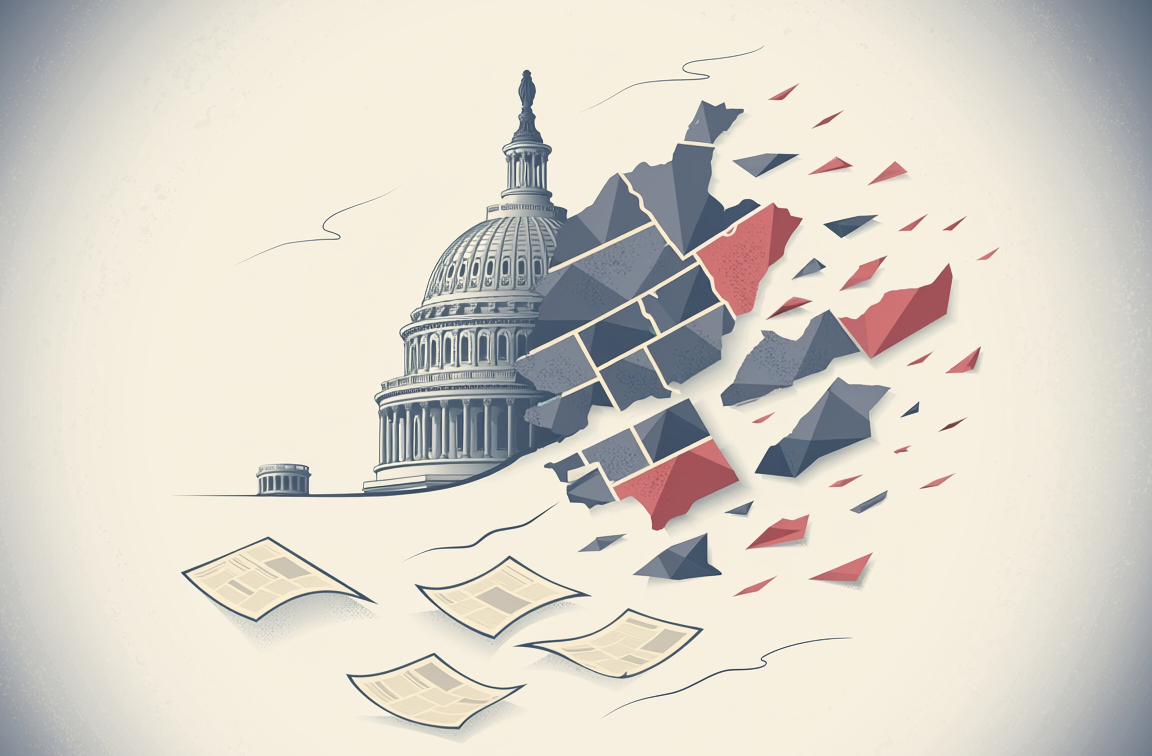
Those are important questions, but the deeper story is not about whether Republicans gain four seats or Democrats gain six somewhere else. It is about the steady erosion of the informal norms and democratic institutions that allow constitutional government to function. Gerrymandering is not the disease. It is a symptom.
The Supreme Court of the United States (SCOTUS) established precedent for mid-decade redistricting and further legitimized partisan gerrymandering. In Louisiana v. Callais, the Supreme Court ruled the state's 2024 map invalid due to racial gerrymandering. Specifically, the two majority-Black districts were deemed unconstitutional; a reversal of previous court rulings that the 2022 map violated Section 2 of the Voting Rights Act because there was only one majority-Black district. Now, Louisiana has changed the maps once more to remove the second majority-Black district.
Over the past two decades, Republicans have generally extracted greater electoral advantages from redistricting than Democrats, particularly after the 2010 census, though both parties have engaged in partisan mapmaking where they possess the opportunity. As courts increasingly decline to police partisan gerrymandering, state legislatures have entered an arms race in which each side seeks to maximize its own representation before the other can do the same. The result is a political environment where the incentives increasingly reward partisan advantage over institutional legitimacy.
The gerrymandering war is not merely a reflection of Republican anxieties facing a tough midterm cycle. It is representative of entrenched fears and attitudes that abandon American commitment to its founding principles.
Brief Review of Gerrymandering
For those unfamiliar with the concept, gerrymandering is the act of drawing the boundaries of election districts in such a manner as to maximize one party's vote share. Although there are a few examples of this concept playing out around the world (e.g., Orbán's Hungary and 1990s Kenya), it is predominantly an American issue. In fact, it is so explicit that when electoral maps are challenged in court, the state argues the maps were drawn for partisan, rather than racial, reasons. The landmark ruling from Rucho v. Common Cause (2019) prevents lower courts from striking down maps for partisan gerrymandering, and is often cited in recent cases challenging gerrymandered maps.
Effects of Gerrymandering
In the American context, the issue of gerrymandering relates only to the United States House of Representatives and each respective state House, since these chambers are proportional representative entities. Presidential, Senate, and Gubernatorial elections are not subject to gerrymandering as these are national and state-wide elections, respectively. Given the House's susceptibility to gerrymandering, what impact do we see in its composition?
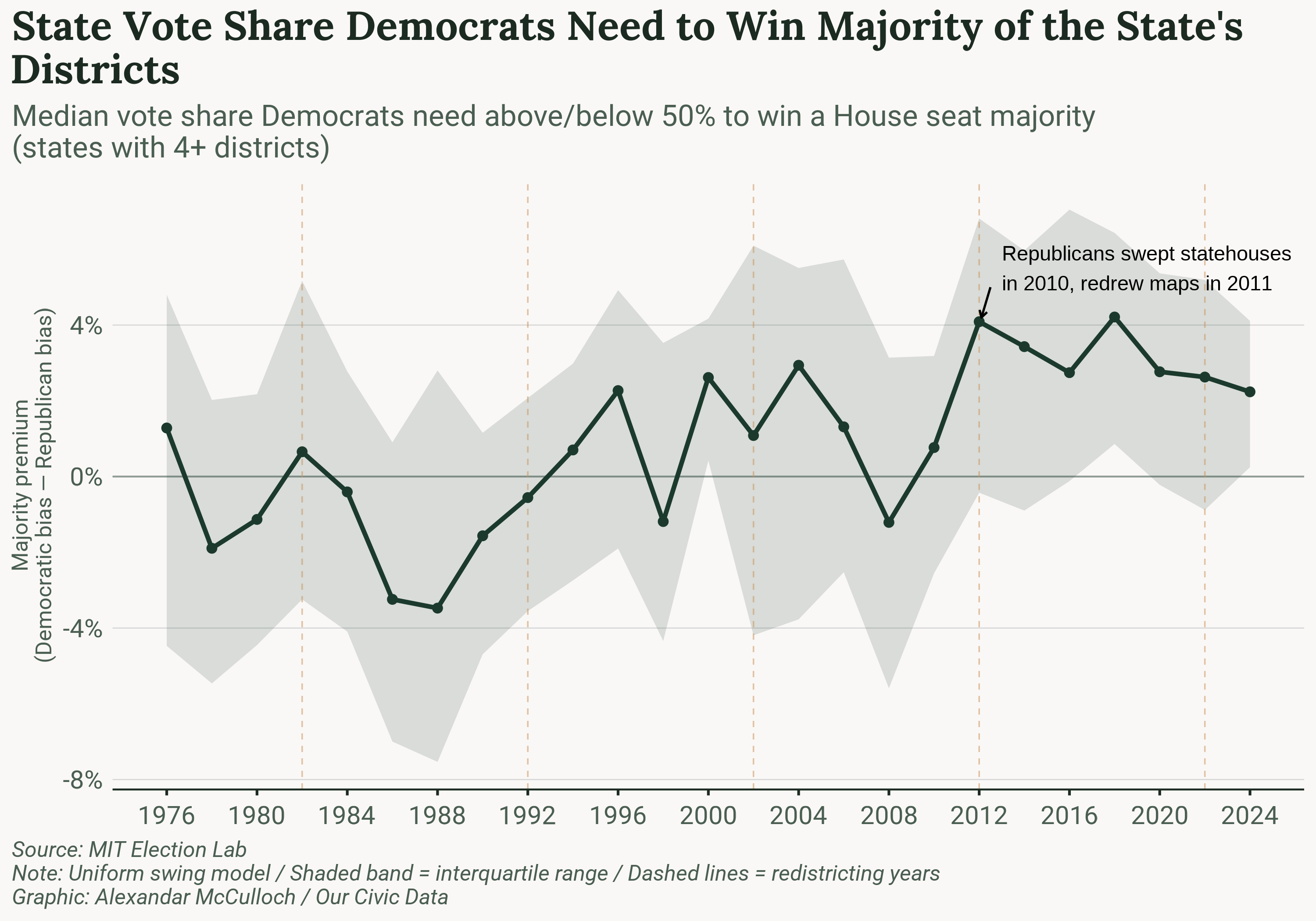
Since 1976, both Democrats and Republicans have had advantages in securing a majority of a state's districts. Between 1984 and 1992, in states with 4+ districts, Democrats needed less than 50% of the vote share to secure a majority of the state's House seats. This advantage quickly faded in the early 1990s. Between 1994 and 2024, Democrats needed to secure more than 50% of the vote share in 13 out of 15 elections. Furthermore, the 2010 election resulted in sweeping victories for state Republicans, allowing Republican state legislatures to redraw maps for the 2012 cycle. Between 2012 and 2024, Democrats needed an average of +3 percentage points above 50% to secure the majority of districts.
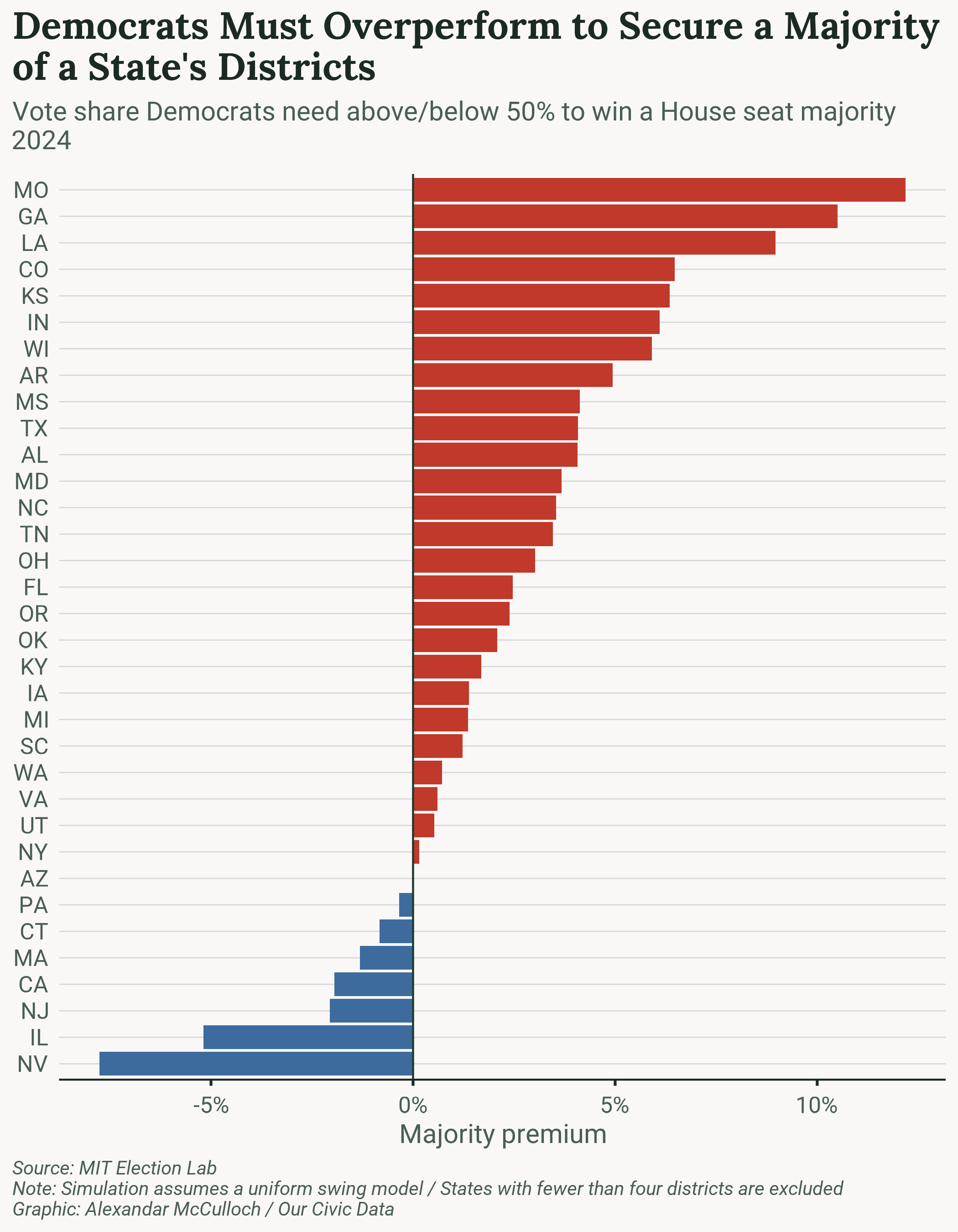
In 2024, Democrats also need to overperform in the majority of 4+ district states. Seven out of 34 favor Democrats (20.5%), with two of the seven favoring Democrats by at least 5 percentage points.
Democratic Backsliding
In 2023, I wrote an article for my Substack discussing the health of American democracy. Only three years removed, not much has changed. American liberal democracy scores continue to decline, and the battle between Democrats and Republicans on election security measures has only become more contentious. The United States is far from the only nation in the world with weakening democratic institutions.
 Alexandar McCulloch
The United Kingdom, for example, has seen a 14% drop in its liberal democracy score since 2020. Overall, freedom of expression is worsening in about one-quarter of the world. This trend extends beyond outright censorship; it includes growing political pressure on independent media, restrictions on public discourse, and the erosion of institutional protections that enable citizens to hold governments accountable.
Laboratories of Democracy
An often-forgotten check in the checks-and-balances conversation of the American government is the role states play in balancing the federal government's power. States are granted a level of freedom to legislate on nearly any area of the law. The U.S. Constitution grants states the authority to conduct elections as they see fit (see the Elections Clause). As a result, election laws vary from state to state.
One benefit of this variability is robust election security. First, this prevents the executive from exerting undue influence on elections in hopes of swaying them in their favor. While a system with centralized authority over elections may tempt authoritarians to abuse their powers, the Elections Clause leaves no room for the president to commit such extreme acts. Second, although the decentralized system makes it harder for national security agencies to protect U.S. elections, it also makes it very difficult for hackers to penetrate these protections and influence election outcomes. Such variability creates complexity that impedes efforts to prevent federal corruption and outside influence; however, this system lays the groundwork for corruption, which state governments seek to exploit to violate civil liberties rather than the federal government.
The Jim Crow era is a perfect example of this. Black Americans were denied the right to vote by poll taxes, white primaries, and literacy tests implemented primarily, but not exclusively, by southern states. The Election Clause allows Congress to regulate how states exercise their authority over federal elections. Thus, the Voting Rights Act of 1965 was passed by Congress to end such discriminatory laws.
This is why political scientist Steven Levitsky has argued that the United States did not become a full democracy until 1965, since universal adult suffrage did not exist before then. Because states control how their own elections are run—and have a history of using that power to restrict who can vote—it follows that each state contributes differently to the country's overall democratic ranking, and that the health of democracy varies from state to state.
State Democracy Index 2.0
To measure the democratic health of each state, Professor Jake Grumbach published the State Democracy Index. To measure the democratic health of each state, Professor Jake Grumbach published the State Democracy Index (SDI 2.0). Using 54 indicators — spanning polling place wait times, voter registration policies, felon disenfranchisement, and more — the index applies Bayesian statistical modeling to produce a single score of democratic performance for each state and year. Scores range roughly from -3 (weakest) to 2 (strongest), and cover every state from 2000 to 2023. Unlike national-level democracy indices, the SDI allows for direct comparison of democratic conditions across states and over time — making visible a story that aggregate U.S. democracy scores obscure.
The map below makes the geographic pattern clear. Democratic health is not randomly distributed across states — it clusters. Southern and Plains states have consistently lower scores, while the coasts and upper Midwest trend higher. But the more important story is movement: several states that scored near the national median in 2000 have drifted significantly downward, particularly after 2010.
What's Driving the Decline?
The SDI captures outcomes, but it doesn't explain the mechanism. To understand why democratic health declines, we need to look at the laws that shape how elections are conducted — and who controls them.
The Cost of Voting Index (COVI), developed by researchers at MIT, measures the relative ease or difficulty of voting in each state. It aggregates policies ranging from registration deadlines and voter ID requirements to early voting availability and polling place access. Higher scores mean voting is harder. Together, the SDI and COVI tell a connected story: states with weaker democratic institutions tend to make voting more difficult, and states that make voting more difficult tend to have weaker democratic institutions.
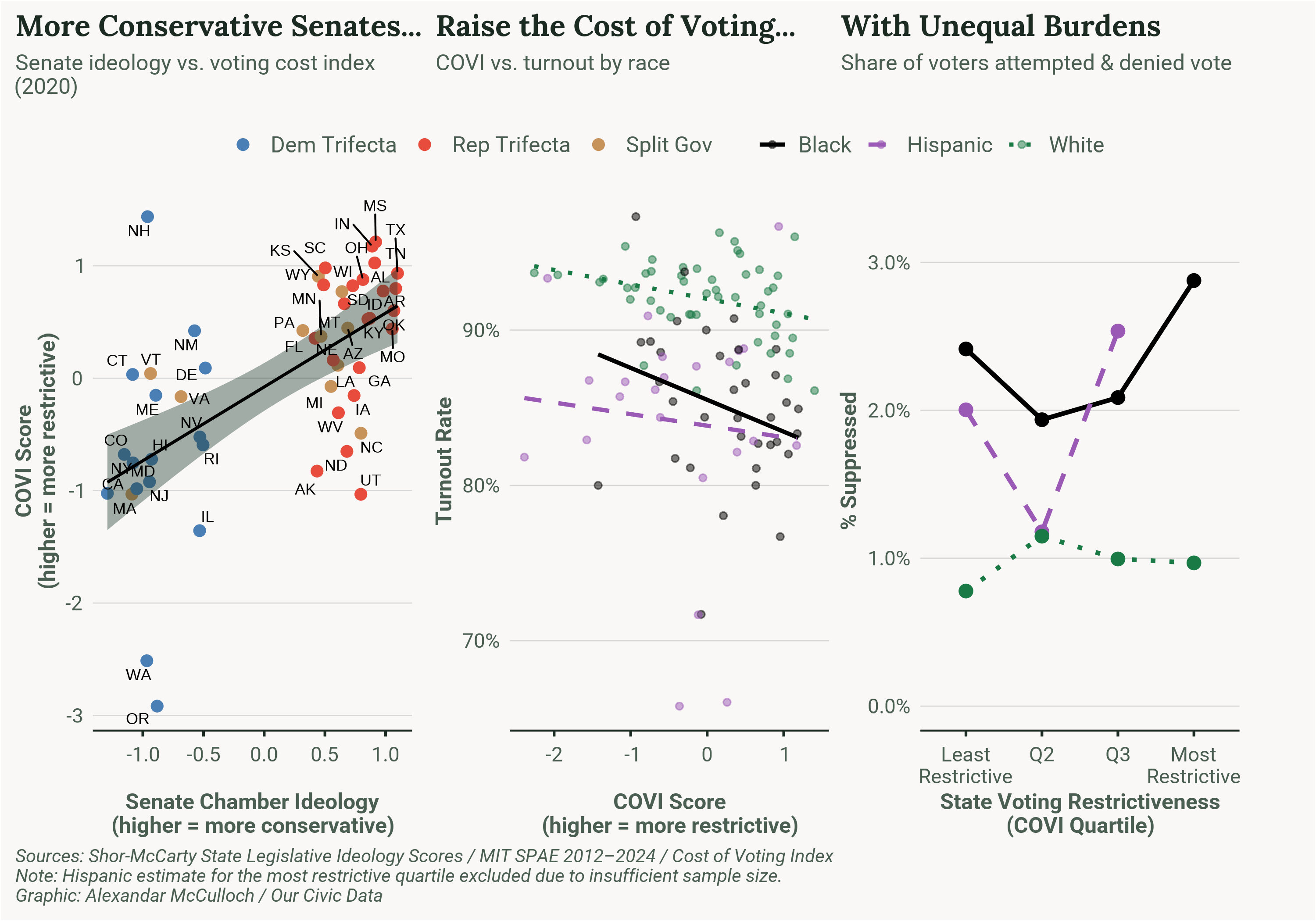
That relationship doesn't emerge from nowhere. As the chart below shows, the ideology of a state's senate chamber is a meaningful predictor of its COVI score — the more conservative the senate, the higher the cost of voting. Not only is this true for states with Republican trifectas (Republican House, Senate, and Governorship), but also for states with split governments. Split governments are still more likely to impose restrictions as the state senate becomes increasingly conservative, regardless of which party controls the governor's mansion or the House.
That association then translates directly into who can exercise the franchise: in states with the most restrictive voting laws, turnout falls. And those burdens are not distributed equally. In the most restrictive quartile of states, Black voters are suppressed — meaning they tried to vote but were prevented — at more than twice the rate of white voters.
One common explanation for racial gaps in voter suppression is that it's really about party, not race. In several recent court cases, Republican lawmakers defending contested district maps have argued that they were sorting voters by politics, not skin color — it just happens that most Black voters are Democrats. If that explanation holds up, we'd expect a simpler pattern in the data: Democrats in general facing more suppression than Republicans, with Black and white Democrats looking about the same once you're comparing people in the same party.
Across every quartile of the Cost of Voting Index, Black Democrats reported higher rates of attempted-and-denied voting than white Democrats. In the most restrictive states, roughly 2% of Black Democrats reported being suppressed compared to under 1.6% of white Democrats. The widest gap appeared in the most restrictive quartile, where Black Democrat respondents were roughly three times as likely to report suppression as white Democratic respondents. When Black and White Republicans are compared, Black Republicans are between three and seven times more likely to report being turned away from the polls, compared to White Republicans. Hispanic respondents showed more erratic patterns across quartiles, largely because there are too few Hispanic respondents in our data to draw confident conclusions cell-by-cell.
Press Freedom
Free elections alone are insufficient for democracy. Citizens must also possess access to independent sources of information capable of scrutinizing those in power. Political scientists therefore treat press freedom as one of the core components of liberal democracy, alongside competitive elections, civil liberties, judicial independence, and protections for political opposition.
Across much of the world, these institutions tend to weaken together rather than in isolation. Governments that manipulate elections often attack independent media, while governments that suppress journalists frequently impose new restrictions on political participation. Democratic erosion is rarely a single event. It is typically an accumulation of small institutional changes that gradually reduce accountability.
Press freedom has declined worldwide in recent years. According to Reporters Without Borders, "over half of the world’s countries now fall into the “difficult” or “very serious” categories for press freedom."
From 2025 to 2026, Niger and Ecuador have the largest drops in worldwide press freedom rankings, with Niger dropping 37 spots and Ecuador 31. Such an extreme crackdown on press freedom comes after the 2023 Nigerien coup, where the presidential guard placed President Mohamed Bazoum under house arrest, suspended the constitution, and criminalized independent reporting under "national security" and "cybersecurity."
Ecuadorian journalists are not only targeted by political institutions, but also must navigate an increasingly dangerous media landscape, where cartels and gangs assault, threaten, and murder journalists.
In the United States, Americans have expressed misgivings towards "legacy media" and journalism overall. More than half (56%) say they do not trust journalists to act in the public's best interest. Republicans are far less likely to trust media and typically curate their newsfeed. According to one 40-year-old Republican voter, interviewed by Pew Research,
It used to be, as a kid, I could just turn on the news on TV and it’s like everything is believable and credible, … But in a world where everything has become much more biased, and there’s unreliable and biased sources, you have to kind of take things with a grain of salt and look at where is it coming from, and who’s the source, and what is their main goal? And you just have to put a filter on it.
Simultaneously, violence directed towards journalists has been steadily rising, as shown on the map below. The first major spike, in June 2024, coincided with widespread campus protests over the war in Gaza, where journalists covering demonstrations were assaulted, detained, or otherwise obstructed by protesters and law enforcement alike. A second spike occurred in April 2025 during demonstrations surrounding federal Immigration and Customs Enforcement (ICE) operations. As with the 2024 protests, reporters covering rapidly evolving confrontations frequently found themselves caught between demonstrators and police, resulting in a sharp increase in assaults, arrests, and interference with news gathering.
Subscribers can submit a topic suggestion below. Sign up to suggest what I should cover next!