
Labour secured its largest electoral victory on 4 July 2024, since the Tony Blair landslide of 1997, winning 411 seats—an increase of 209 from the 2019 election. Despite this dramatic turnaround, current polling places Labour at just 22%, nearly 20 points lower than their result in the 2024 election. With a historically low turnout, it was understood that Labour's massive victory represented a censure of the Conservative Party rather than fervent support for Labour—one year in, Prime Minister Keir Starmer's promises to bring order to chaos ring hollow. Protests emerged when Sir Keir announced cuts to Britain's welfare budget, and after a rebellion of Labour MPs, he was forced to abandon his legislation.
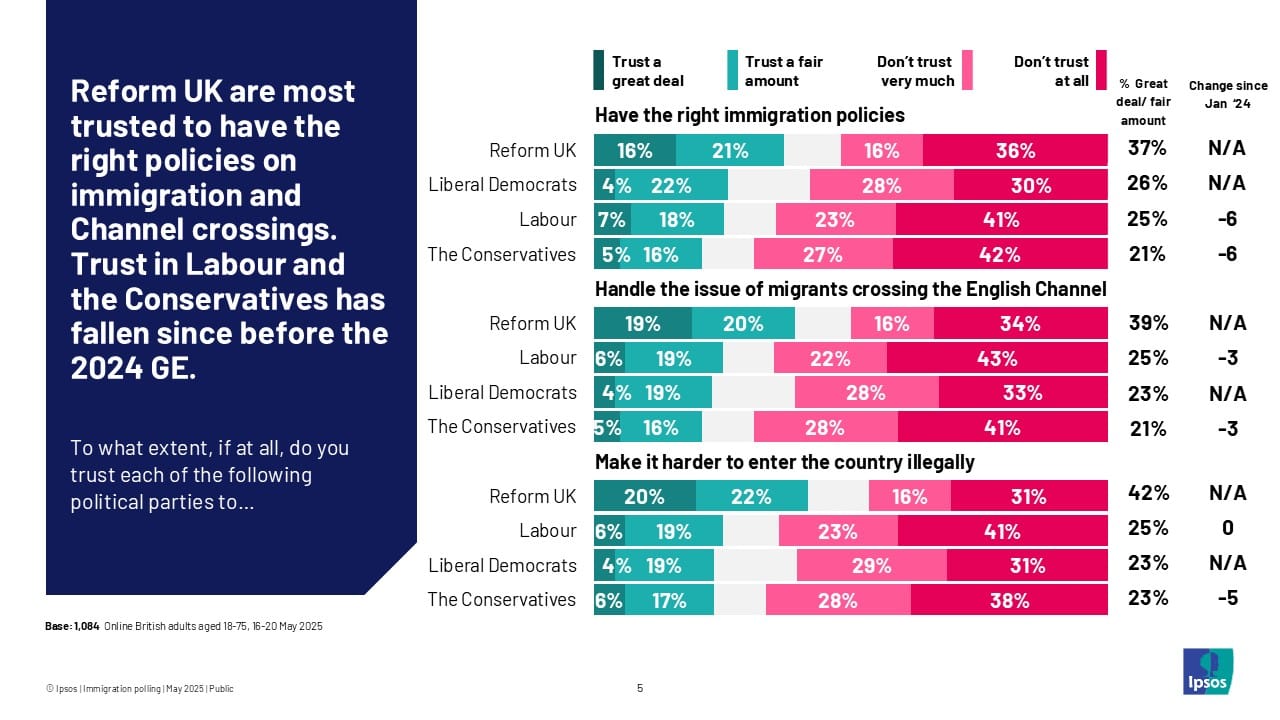
Addressing welfare and healthcare in general is not a priority for the public. Instead, immigration is currently the top issue for British adults, which likely explains the drastic rise in preference for Reform UK leadership. Reform UK and Nigel Farage are the most trusted to handle migrant crossings of the English Channel and make illegal entry more difficult. Only around one quarter of British adults trust Labour and the Liberal Democrats on these same issues.
Europe Moves Right
The rise in Reform UK is following a larger trend that other European countries are experiencing. The AfD, for example, Germany's far-right party, has become the country's most popular political party. The AfD surged to 26% support, a dramatic rise from the 20.8% it achieved in February 2025's federal election, emboldening the party ahead of the 2026 state elections. The AfD had roughly doubled its support since 2021, reflecting the party's increasing legitimacy as a political force within Germany.
Germany is not alone. For the first time in modern history, far-right parties are leading opinion polls in Europe's four largest economies. In France, Marine Le Pen's National Rally is now the largest party in the French parliament, though it lacks a majority. In Austria, the far-right Freedom Party topped polls in September 2024. In the Netherlands, Geert Wilders's far-right Party for Freedom topped legislative elections in 2023 and eventually reached a coalition agreement with three right-wing parties. Fortune As of late 2025, far-right parties head the governments of four EU member states: Belgium, Italy, the Czech Republic, and Hungary. Stiftung Wissenschaft und Politik
The momentum shows no obvious ceiling. With national elections approaching in France, Italy, Spain, and Poland within the next two years, far-right parties are well-positioned to convert their polling leads into governing power on an unprecedented scale.
A Continent Anxious About Immigration
The specter of Europe's 2015 migrant crisis still haunts its political parties. The arrival of more than 1.3 million Middle Eastern migrants fueled populist and nationalist sentiments, producing cultural and economic anxieties. Anxieties that center-left parties are not trusted to assuage.
These uncertainties have opened Europe's Overton window ever more widely, as perceived policy failures force both center-right and left-wing parties to adopt increasingly hardline stances on immigration. Prime Minister Keir Starmer's rhetoric on illegal Channel crossings, for example, has toughened in response to this public sentiment.
Yet immigration is only part of the story. Some far-right voters display strong cultural concerns over immigration, others are motivated by economic anxieties, and still others do not report significant immigration concerns at all, voting for the far right as a protest against social and economic grievances. Research from the European Parliament elections of 2024 similarly found that younger voters are less committed to liberal democratic norms and more likely to favor a "strong leader," with young men disproportionately driving this trend.
Other researchers argue that the root of far-right support lies not only in fear of immigration, but in the inherent inequalities of modern economies—as the poorest citizens lose a share of national income, far-right vote shares rise. Stagnating wages, rising housing costs, and the perception of an out-of-touch political establishment have all contributed to the fracturing of traditional party loyalties across the continent.
The Firewall Weakens
For decades, European mainstream parties maintained a so-called cordon sanitaire—a political firewall designed to prevent far-right parties from entering governing coalitions. The durability of the cordon sanitaire is now in question. Their growing electoral success is making the strategy increasingly difficult to maintain.
The continued erosion of traditional political barriers, such as German Chancellor Friedrich Merz's recent decision to cooperate with the AfD at the local level, may be viewed as a necessary pragmatic move by some, though critics warn it risks normalizing extremist positions. Experts on the far right warn that this approach tends to benefit the challenger rather than the mainstream party adopting its language. As one researcher summarized: copying the far right's rhetoric on immigration does not return votes—it simply validates the original.
Whether Europe's centrist parties can recover ground without surrendering their liberal democratic identity remains the central political question of the decade. For now, the evidence suggests the populist wave has not crested. Germany is not alone. Across Europe's four largest economies, far-right parties now lead opinion polls—a development without precedent in the postwar era. In France, Le Pen's National Rally has become the largest single party in the National Assembly, though it has yet to translate that position into executive power. Austria's Freedom Party finished first in the country's 2024 parliamentary election. The Dutch coalition that eventually formed after Wilders's 2023 victory included his Party for Freedom, with a technocratic prime minister installed as a compromise. By the end of 2025, four EU member states—Belgium, Italy, the Czech Republic, and Hungary—were governed by far-right parties or coalitions in which they held dominant influence.
With major national elections on the horizon in France, Italy, Spain, and Poland, the next two years will test whether these polling leads can be converted into governing power on a still broader scale.
Whether Europe's governing center can stabilize its position—without either capitulating to far-right demands or continuing to hemorrhage voters to them—is perhaps the defining political challenge of this decade. The evidence so far offers little reassurance that it has found a workable answer.